
The Hebbian Corpus · A Mind Development Life Cycle
Experience builds the mind.
Software is authored once and then it executes. A mind is developed, over a life, by what happens to it. This is the life cycle the Webspinner Foundation is building to develop minds that way: fit for a purpose, grounded in evidence a person admitted, and measured at every stage.
“A corpus is not knowledge. It is the experience from which knowledge can emerge.”
John David Marx, Founder of the Webspinner Foundation
The ledger, as it stands
Every figure here is read from the record.
The MDLC keeps an append-only ledger of everything it has gathered, read, admitted and refused. These numbers are a snapshot of it. None is typed by hand; each is painted from the snapshot when the page loads.
Kept as the bytes that arrived, with who fetched them, from where, and when.
Statements cut from those sources, each traceable to its exact span.
Only these can reach a Mind.
of everything judged was kept out. The gate is doing its work.
Exactly one version of each serves. earlier versions are retired, not deleted.
Every ask is written down: the Learn stage. have been judged.
Snapshot of the MDLC ledger taken . How these are made.
Donald O. Hebb, 1949 — Carla Shatz, 1992
Fire together, wire together.
Hebb proposed that when one cell repeatedly takes part in firing another, the connection between them grows claim 3850. The phrase everyone quotes came later, from Carla Shatz claim 154. The network below runs that rule. Move across it, or teach it a pattern, and watch connections form, hold and fade.
This is the same form of rule the corpus uses to rank its own claims. A claim that keeps coming back together with others, in answers whose work was accepted, is lifted a little. Evidence still decides what is relevant; use only breaks ties. In the corpus the half-life is thirty days.

The method
Six stages, and the last feeds the first.
Collect the corpus. Preprocess and tokenize. Train the model. Embed for context. Inference and interaction. Continuous learning.
The cycle is closed by construction: the last stage's output is the first stage's input. Its return arrow reads “Real-world experience feeds a stronger tomorrow.” Each stage below shows where the hebbian Mind stands in it now, read from the ledger.
Measured, not claimed
The same model, with and without the corpus.
The same question goes to the same model twice: once bare, once bound to the Mind's admitted claims. The markers that decide a correct answer are written down before the run. One question is a control, one the corpus cannot answer, and it must be refused. These are the recorded answers, word for word.

AIOps for AI-native development
DevOps shipped binaries. This ships minds.
A build pipeline makes software releasable every day. The MDLC is meant to do the same for expertise: automated, repeatable, gated, and releasing often, with a person deciding what a mind may learn from.
“This ie the evolution of all I have learned about DevOps and Platform Engineering so that a multi-deminsional synaptic pipeline may be established to create the rapid releases of fit for purpose sovereign Ai.”
John David Marx, 28 September 2026 — verbatim
In service now
Minds, each fit for one purpose.
A Mind here is not a new model. It is a contract, a frozen set of admitted claims, and a base model, and it is promoted to service only on a recorded evaluation. Lift is how much better the grounded answers scored than the bare ones.
Where this runs
The Inference Desktop.
The MDLC is meant to run where a patron can reach it, not only in an engineer's terminal. That place is the Inference Desktop: a portable layer that sits beside macOS, Linux and Windows. The model never touches the machine. It proposes a typed plan, and deterministic code verifies it, previews it and commits it. Every step is journalled with its inverse, so it can be undone exactly, or it is reported as irreversible before it runs.
Make the tools first
“To stop wading in Shat we have to act like the cave man. Make the tools first, fire later.” — John David Marx. The Desktop is the drill; each outcome is the fire.
Sovereign by rule
No runtime dependency on rented inference. The Minds answer from models on the Foundation's own hardware.
Augmented, not replaced
Machines may gather and grade. Only a named authority may admit what a mind learns from, and every admission records who made it.
Walk the Vault
A space to walk through the corpus as the Vault is drawn: the sources on its shelves, each claim on a card, the refused ones set aside. In production.
The Desktop, at work
A film of a Mind being developed in the Desktop, stage by stage, from the recordings of the work itself. In production.
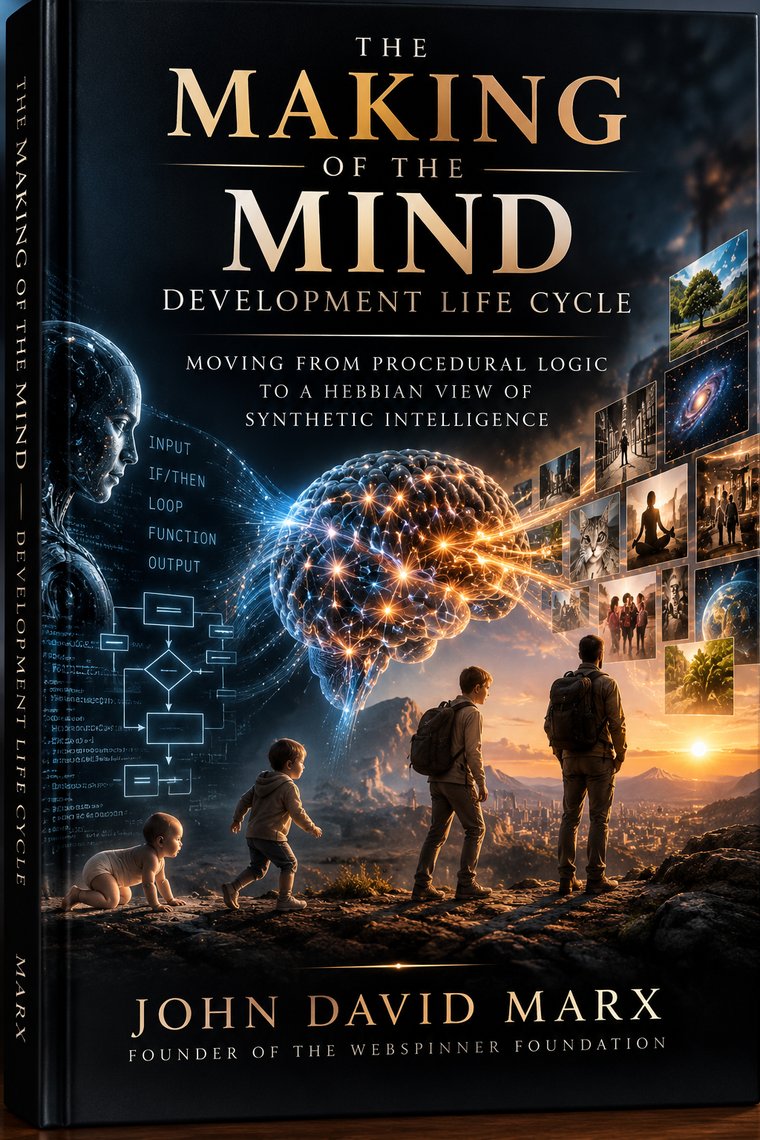
The textbook
The Making of A Mind
John David Marx is writing the textbook of the MDLC from the record of the work itself, in prose and in video.
Its argument, as the cover states it: moving from procedural logic to a Hebbian view of synthetic intelligence.
Shared, not reserved.
The Hebbian Corpus and the Inference Desktop are funded and stewarded by the Webspinner Foundation. The writing, films and teaching materials are shared under Creative Commons BY 4.0. The software is free of charge under the nosource agreement. It is not open source.
Webspinner is in prelaunch. Much of what is described here is work in process rather than a proven production release, and it is shared as it stands so that others can build on it. Where something is not done, the site says so.